Italy’s new EFS Guidelines: a milestone for Europe’s medtech innovation ecosystem
May 2026
Early Feasibility Studies (EFS) are a critical step in the medical device evidence‑generation lifecycle. They allow innovators to assess initial safety, usability, and performance of an innovative device at an early stage, before the final design is locked, while ensuring patient protection and regulatory oversight.
For years, Europe has struggled to retain early‑stage medical device studies. Fragmented national procedures, rising compliance costs under the EU Medical Device Regulation (MDR), and the absence of a structured early‑innovation pathway have pushed first‑in‑human and early feasibility trials to other regions. Italy’s newly published National Guidelines on Early Feasibility Studies for Medical Devices (February 2026) aim to change that dynamic.
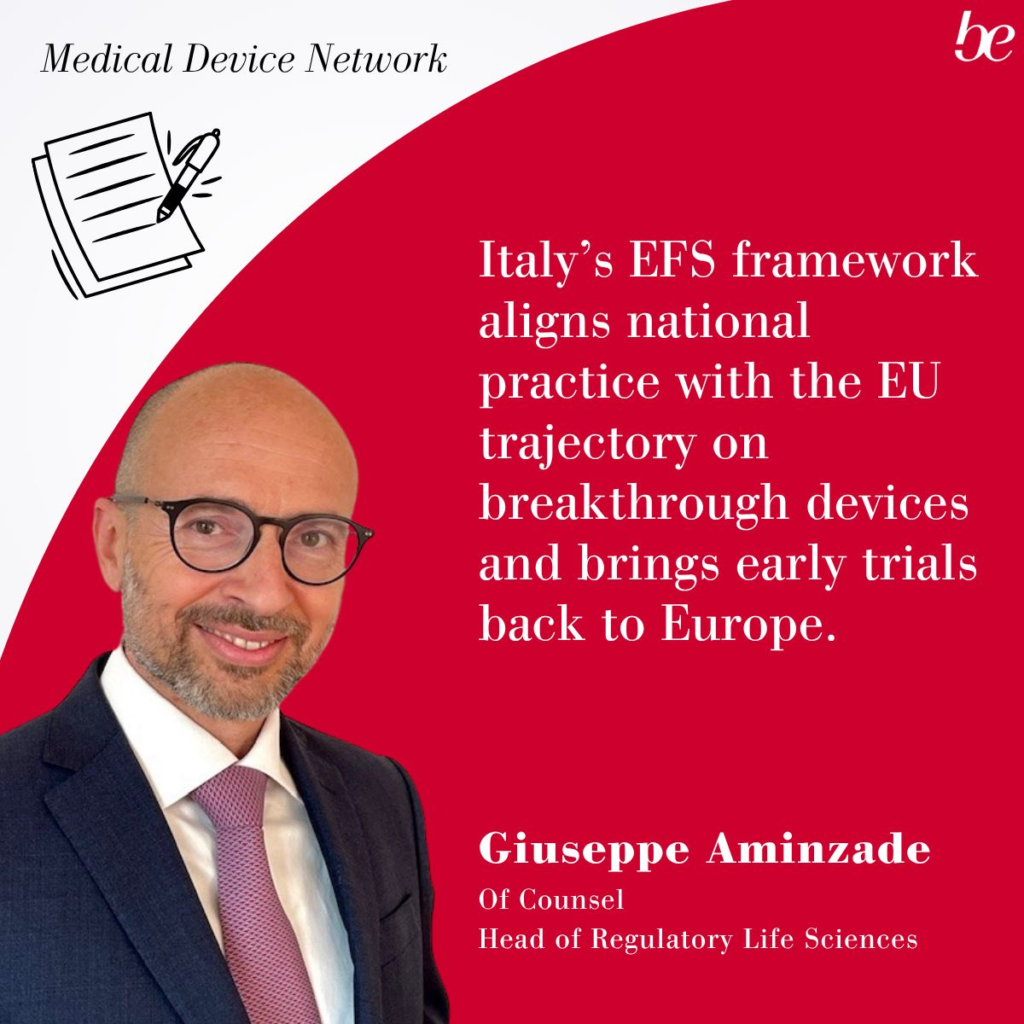
The Italian Guidelines establish a clear, MDR‑compliant framework for conducting EFS, explicitly anchoring them under the MDR clinical investigation architecture rather than national exemptions. This approach provides legal certainty and regulatory predictability, two elements that have been historically lacking for early‑stage studies in Europe.
Crucially, the framework is designed around the specific nature of EFS. It allows small sample sizes, staged enrolment, adaptive and modular protocols, and proportionate documentation requirements aligned with early development. Streamlined authorisation timelines and centralised ethical review are intended to make EFS faster to initiate, without compromising safety or scientific integrity.
This national step is closely aligned with the objectives of HEU‑EFS (Harmonised Approach to Early Feasibility Studies for Medical Devices in the European Union). Italy’s Guidelines reflect the core HEU‑EFS principles: harmonisation across Member States, proportionality, lifecycle evidence generation, and practical tools that support both innovators and clinical sites.
Arriving alongside broader EU initiatives, such as the proposed MDR/IVDR revisions and emerging EU‑level breakthrough device pathways, Italy’s EFS framework acts as a real‑world pilot for how early feasibility studies can be conducted consistently across Europe.
If successfully implemented and replicated, this model could strengthen Europe’s competitiveness in medical device innovation and ensure that early clinical learning increasingly happens with European patients, in European healthcare systems.
Read the whole article here!